Most companies say that appraisals are meant to improve performance.
In many organisations, they do something else. They create anxiety, paperwork and political behaviour without improving the work itself.
The problem is not limited to the final appraisal meeting. The cost starts months earlier.
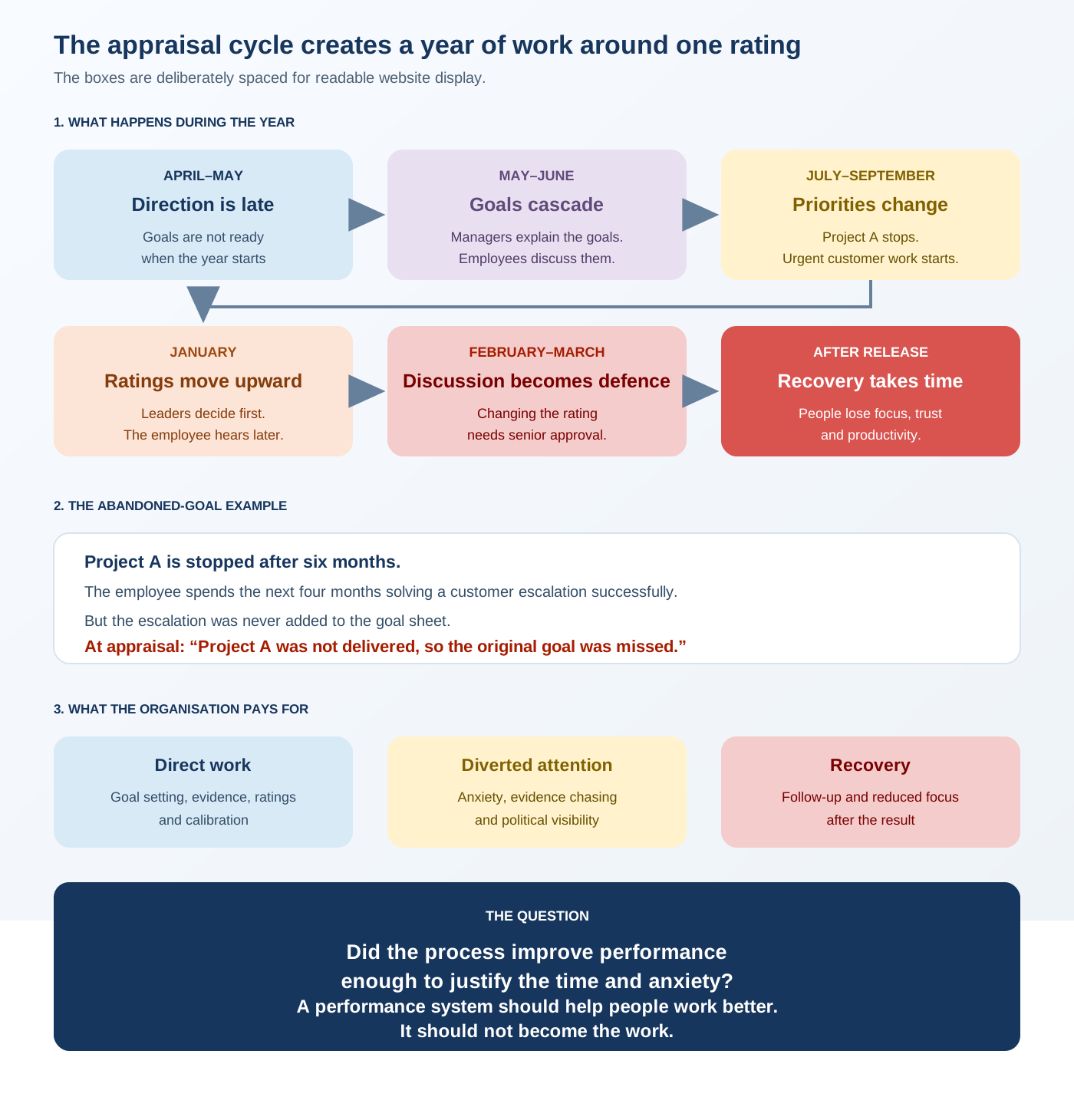
Goals may not be available until April or May. Priorities may change by the middle of the year. Managers may submit ratings to leadership in January, before employees have had a meaningful discussion about their performance. By the time the employee hears the rating, the room for changing it may already be very small.
The employee discussion then becomes less like an assessment and more like an explanation of a decision that has already travelled upward.
This is the first chapter in a series that proposes a practical alternative: the Low-Anxiety Performance System. The aim is not to remove accountability. It is to remove avoidable uncertainty, duplicated work and surprise.
This is a high-level concept based on my experience, observations and thoughts about appraisal systems, supported by the research linked in this series. It is not a claim that every organisation behaves in exactly the same way. The calculations are a practical starting model; each organisation should replace the example assumptions with its own measured data.

The process looks longer than the work it is supposed to measure
Consider a normal April-to-March appraisal year:
- Leadership takes time to decide the direction.
- The direction moves through several management layers.
- Managers convert it into team goals.
- Managers cascade the goals to other managers.
- Managers explain the goals to employees.
- Employees negotiate or clarify what the goals mean.
- By the time the goals are agreed, one or two months may have passed.
- Business priorities change.
- The old goals are not always formally rewritten.
- Managers prepare ratings before the employee discussion.
- Leadership and HR calibrate the ratings.
- The manager communicates the rating to the employee.
- Changes require justification upward.
- Final ratings are communicated again.
- Employees and teams take time to recover from the uncertainty and disappointment.
The official process may be called an annual appraisal. The practical process can occupy much of the year.
A filled example
Imagine a 500-person organisation with 50 managers, 10 HR staff and 15 senior leaders.
The organisation estimates:
- 4 hours for senior leadership to set direction and constraints
- 8 hours per manager to cascade the direction into team goals
- 1.5 hours per employee for goal explanation
- 1 hour per employee for clarification and negotiation
- 6 hours per employee for self-appraisal and evidence collection
- 8 hours per manager to review evidence and prepare ratings
- 24 hours per manager for calibration
- 3 weeks during which employees may divert several working hours each week to anxiety, evidence collection and appraisal preparation
- 2.5 weeks of reduced productive capacity after the announcement while people process the outcome and the organisation handles follow-up
Using loaded employment costs, the filled example produces an estimated annual burden calculated from these separate activities. The calculator does not assume that every person spends the same amount of time.
That is not a claim that every organisation loses exactly ₹7.27 crore. It is a method for making the hidden cost visible.
The estimate has three parts:
| Cost category | Example annual cost |
|---|---|
| Direct appraisal, goal-setting and data-collection work | ₹1.03 crore |
| Anxiety and diverted attention in the base scenario | ₹6.24 crore |
| Total estimated burden in the base scenario | ₹7.27 crore |
The important point is that the cost is not only the time spent filling forms. It also includes productive work that does not happen at normal capacity.
The abandoned-goal problem
Six months later, the company stops Project A and moves an employee to a customer escalation. The employee spends four months solving the escalation successfully.
At appraisal time, the manager says:
Project A was not delivered, so the original goal was missed.
The customer escalation may be mentioned, but it was never formally added to the goal sheet. The employee is judged against a plan that leadership abandoned.
This is not an unusual edge case. It is a predictable result of treating annual goals as fixed commitments while allowing business priorities to change freely.
The employee should not have to spend another week proving that the replacement work happened. The priority change itself should be part of the context.
Why anxiety is a business cost
Anxiety affects the process before the rating is announced:
- Employees collect evidence instead of focusing fully on delivery.
- Managers spend time preparing justifications.
- People become more cautious about taking risks.
- Collaboration becomes political because colleagues may be competing for limited rating categories.
- Employees try to become visible near appraisal time.
The cost also continues after the announcement. An employee may spend days or weeks thinking about the rating, discussing it with colleagues, seeking clarification or deciding whether the organisation still values their work. Managers then spend more time on follow-up, explanations and exceptions.
This is why the recovery period belongs in the calculation. A two-hour meeting may trigger several weeks of reduced attention across a team.
The evidence does not say that all feedback is bad
Feedback can help. The issue is the way organisations package it.
Gallup data cited by the Financial Times found that only 14% of employees strongly agreed that performance reviews inspired them to improve. The same report said that only 2% of surveyed Fortune 500 HR leaders strongly agreed that their performance-management system inspired improvement. Financial Times
Research by Kluger and DeNisi found that feedback improved performance on average, but more than one-third of feedback interventions reduced performance. Feedback is therefore not automatically useful. Its timing, quality, credibility and framing matter. Hebrew University research record
The practical conclusion is not “stop giving feedback”. It is:
Give useful feedback while there is still time to act on it. Do not save every judgement for a high-stakes annual event.
The first design rule
The Low-Anxiety Performance System begins with one rule:
No employee should receive serious negative feedback for the first time during the final appraisal.
If there is a real concern, the manager should raise it when it happens. The employee should know what is wrong, what support is available and when the issue will be reviewed.
If there is no serious concern, the organisation should not create months of paperwork to prove that normal performance occurred.
A practical test for HR and leadership
Enter the actual figures into the Chapter 1 Appraisal Cost Calculator. Count:
- Employees involved
- Managers involved
- HR and leadership hours
- Goal-setting hours
- Data collection hours
- Calibration hours
- Anxiety period before the announcement
- Recovery period after the announcement
- Estimated percentage loss of productive capacity before the announcement
- Estimated percentage loss of productive capacity after the announcement
Then compare the result with the value the process is supposed to create.
The organisation should be able to answer:
What decision or improvement did each major appraisal activity produce?
If an activity consumes time but does not improve direction, support, fairness or a real decision, it should be removed or redesigned.
Use this tomorrow
Do not begin with another survey. Use the filled Chapter 1 calculator and enter the actual numbers from your organisation.
At minimum, measure:
- Time leadership spends deciding priorities
- Time managers spend cascading goals
- Time managers spend explaining goals to employees
- Time employees spend clarifying or negotiating goals
- Time lost when goals change and must be re-explained
- Time spent on self-appraisals and evidence collection
- Time spent in calibration and senior-management review
- Time spent on rating changes and follow-up
- The number of weeks during which employees report reduced focus before and after the announcement
Then answer three questions:
- How much time did our last appraisal consume?
- How many ratings changed after employee discussions?
- How many concerns were raised for the first time during the final appraisal?
If the process takes weeks and the outcome is mostly predetermined, the organisation is not improving performance. It is administering a ritual.
The calculator uses low, base and high scenarios based on productive hours diverted per person, rather than a neat percentage reduction. There is no reliable appraisal-specific study that establishes one universal number. The research supports dissatisfaction and performance risk, but not a precise number for every company. Replace the scenario assumptions with measured internal data when available.
The direct administrative burden is easier to measure. Deloitte reported that its old performance process consumed about two million hours annually, while Adobe’s previous annual review process was estimated to consume 80,000 manager hours. Financial Times Chartered Management Institute
What this series will build
The next chapters will turn this argument into a working system:
- How leadership decisions create delayed goals
- Why detailed goal cascades become obsolete
- Why frequent check-ins can distribute anxiety instead of removing it
- How to give broad direction without abandoning employees
- How HR, managers and employees need different tools
- How pay, promotion and performance can be separated
- How to run a 90-day pilot
- How to calculate whether the replacement actually saves time and reduces anxiety
The purpose of performance management is to help people perform their roles. It should not become a yearly anxiety project.
The purpose is to help capable people understand what matters, make decisions and ask for help without spending a large part of the year preparing to be judged.
Series: The Low-Anxiety Performance System · Next: The Problem Starts at the Top